Redfin put Panama City's March 2026 median at $293,000, down 11.6% from a year earlier, with homes averaging 85 days on market against 75 the year before. A buyer reading that number and pulling up a map of The Cove will draw the wrong conclusion. The peninsula does not price like the city it sits inside, and it does not price like itself from block to block.
The Cove is one ZIP code holding four different markets. They are sorted less by square footage than by which body of water a lot touches and whether a fixed bridge sits between that water and the pass to St. Andrew Bay. A buyer who understands that sort will read listings very differently than one who is still averaging.
The citywide median is describing a different buyer
That 11.6% decline is a citywide figure. It absorbs new construction on interior streets, small-lot cottages, condos, and the thin slice of true waterfront that trades on its own logic. Applied to The Cove, it mostly describes the interior tier, where price is elastic to mortgage rates and inventory. The deep-water tier answers to a buyer pool that shows up with cash, a boat, and a short list of navigable addresses in the Florida Panhandle. Those two pools do not move on the same curve.
Think Real Estate's team sees this play out in how offers cluster. Interior Cove listings compete against Lynn Haven and St. Andrews at similar price points. Deep-water Cove listings compete against Bay Point and canal-front Panama City Beach. Same peninsula, different weather.
Four sub-markets on the same peninsula
The Cove was platted between the early 1900s and the 1950s on a peninsula bordered by Massalina Bayou, Bunkers Cove, Lake Van Vac, and Watson Bayou. That geography created the sort.
Cove Pointe and Watson Bayou
Cove Pointe was developed along Watson Bayou, which runs to St. Andrew Bay and out to the Gulf without a fixed bridge between the neighborhood and the pass. For a buyer whose boat has a mast or a tall tower, that unrestricted clearance is the entire thesis. It is why 1164 Cove Pointe Drive, a four-bedroom of about 3,574 square feet, carries a $2.349M ask, and why a six-bedroom, roughly 5,649-square-foot home at 526 Bunkers Cove Road went pending at estate pricing. Buyers in this tier are not comparing dollars per square foot against interior blocks. They are comparing against every deep-water address between Destin and Apalachicola.
Interior Cove Pointe lots without water frontage clear at a very different number. A 10,019-square-foot lot at 335 Watson Bayou Circle listed at $165,000 tells you what raw land inside the same subdivision costs when it is one row back.
Bunkers Cove and the estate blocks
Bunkers Cove holds the neighborhood's largest historic parcels, mature live oak canopies, and the widest range of vintages. A renovated three-bedroom at 1000 E 4th Street listed at $429,900 and a five-bedroom at 1006 E 2nd Court at $424,750 illustrate the middle band, where a buyer is paying for lot size, tree cover, and proximity to water rather than direct frontage. The ceiling in this tier is set by whichever homes on Bunkers Cove Road come to market in a given quarter, and it is high enough that a citywide median tells you almost nothing about it.
Massalina Bayou and the sailboat problem
Massalina Bayou is protected water, which sailors love for safe harbor and which the market prices carefully. The bayou is spanned by fixed bridges before it opens to the bay. That means a lot with Massalina frontage can hold a slip and a dock but cannot promise unrestricted mast clearance out to the pass. Buyers who want a sailboat address read Massalina and Watson Bayou as two different products. Buyers who want a protected trawler slip, a paddleboard launch, and a downtown-adjacent walk read Massalina as the better buy at a lower entry.
The Massalina shoreline is also where the rental stack sits, including the restored Magnolia Cove community on Harmon Avenue, which affects what a new owner can expect for short-term comps on the bayou side.
Interior craftsman blocks and the Cove Condominium
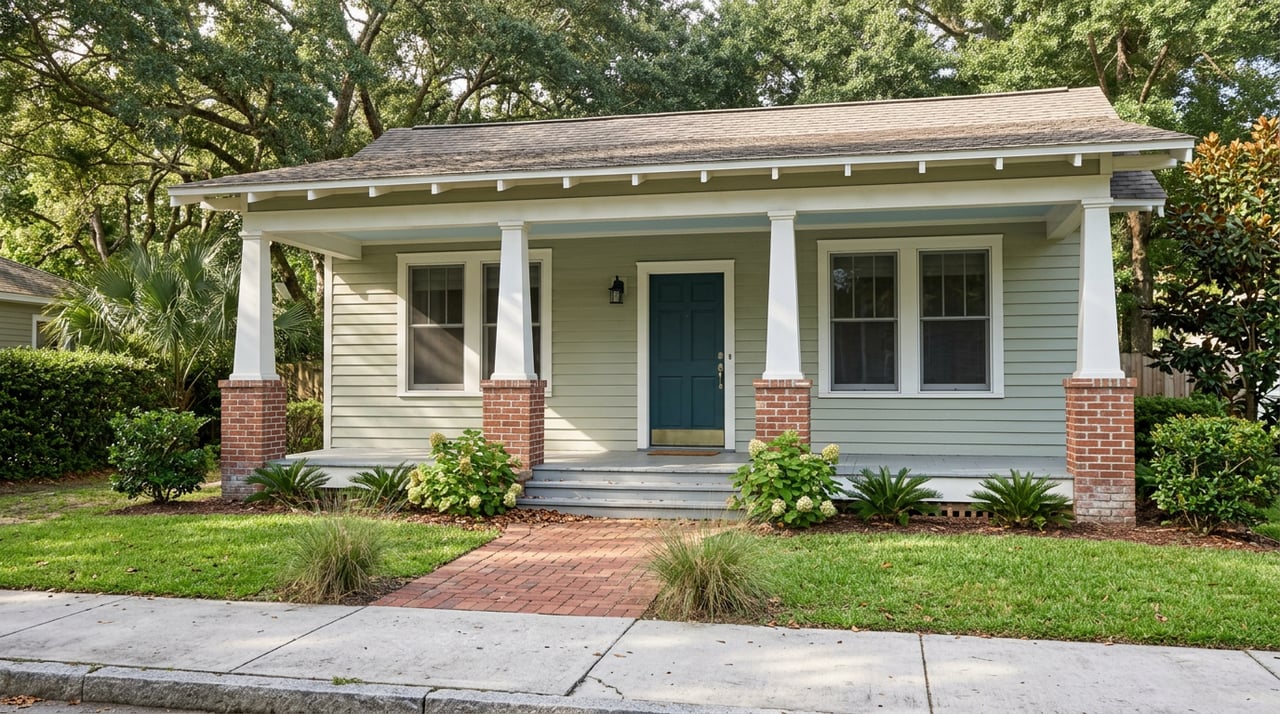
Interior blocks are where the citywide decline shows up most directly. A three-bedroom new-construction listing at 848 E 12th Court asking $175,000 and a two-bedroom at 301 Bunkers Cove Road at $199,999 anchor the entry point. This is the tier that lets a first-time buyer own a home two blocks from historic downtown Panama City, walk to Harrison Avenue on Saturday, and never touch a boat.
The Cove Condominium at 100 Cherry Street is its own micro-market inside the sort. Recent closings there include a two-bedroom at $220,500 in April 2026, another two-bedroom at $299,000 the same month, a one-bedroom at $215,000 in February 2026, and a three-bedroom at $399,000 currently listed. The building is priced against downtown condo comps rather than Cove single-family homes, which is why it is possible to own a Cove address for under $220K without owning a lot.
A comparison the median cannot show
| Sub-market | Water context | Representative 2026 price band | Buyer pool |
|---|---|---|---|
| Cove Pointe / Watson Bayou frontage | Deep water, unrestricted bridge clearance | $2M and up on frontage | Regional deep-water boater |
| Bunkers Cove estates | Large lots, some frontage, mature canopy | $425K to seven figures | Move-up local, second-home |
| Massalina Bayou frontage | Protected water, fixed-bridge restricted | Mid-six figures to low seven | Trawler, paddleboard, walkability |
| Interior craftsman blocks | Walkable to downtown, no frontage | $165K to $450K | First-time, renovator, downsizer |
| Cove Condominium, 100 Cherry St | Bayou-adjacent condo stack | $215K to $400K | Lock-and-leave, downtown lifestyle |
Read left to right, the peninsula is not a spectrum of the same product. It is four separate transactions that happen to share a school zone and a set of parks that include Joe Moody Harris Park and Massalina Bayou Park.
The bridge-clearance premium is the mechanism nobody prices online
Portal search filters let a buyer sort by waterfront yes or no. They do not let a buyer sort by whether the water route to St. Andrew Bay passes under a fixed span. On the Cove peninsula, that distinction is the single biggest lever on the top of the market. Two homes with identical square footage, identical docks, and identical seawalls can carry a spread of several hundred thousand dollars because one lives on Watson Bayou with clear passage and the other lives on Massalina with a bridge in between.
That mechanism also explains why days-on-market inside The Cove diverges from the citywide 85-day figure. Interior listings often run longer than the average because the buyer pool is rate-sensitive and comparing across neighborhoods. Deep-water listings can sit for a season and then close in a week when the right regional buyer surfaces. The average of those two behaviors is not descriptive of either one.
What this means at the negotiating table
Buyers walking into a Cove offer with a citywide median in their head tend to lose one of two ways. Either they anchor too low on a deep-water home because the median suggests softness that does not apply there, and their offer is ignored. Or they anchor at asking on an interior block because the median looks like a floor, and they leave room they did not need to leave.
Sellers make the mirror mistake. A Cove Pointe seller who watches Redfin's citywide chart drop and reduces price is signaling weakness to a buyer pool that was not going to move on rates anyway. A seller on an interior block who holds firm because Bunkers Cove estates are trading well is misreading their own comps.
A cleaner approach for both sides:
- Identify the sub-market before pulling comps. A home two blocks apart can belong to a different pool entirely.
- Ask what the water access actually is. Depth at low tide, seawall condition, and bridge clearance between the dock and the pass matter more than dock length.
- Read days on market by tier, not by ZIP. An 85-day city average tells you nothing about how a $2M deep-water listing will trade.
- Price the lot before pricing the house. On the Cove peninsula, land is the durable asset and structure vintage is the variable.
- Verify the Cove Condominium HOA and reserve posture separately if that building is on the list. Condo pricing there answers to building-level questions, not neighborhood comps.
FAQ
Is The Cove considered part of downtown Panama City for pricing purposes? No. The Cove borders downtown and shares its walkability, but its pricing logic is set by water access and lot vintage, not by downtown redevelopment. A Cove condo and a downtown loft trade on different comps even when they list within a mile of each other.
Does a Massalina Bayou lot appraise like a Watson Bayou lot? Rarely. Appraisers who know the peninsula weight bridge clearance and channel depth, which favors Watson Bayou frontage. A Massalina lot with a well-maintained seawall and a deeded slip can close the gap, but the two are not interchangeable comps.
How does the citywide 11.6% year-over-year decline read against Cove sales? It reads as a rough approximation of the interior tier and the condo stack, and a poor approximation of the deep-water tier. Buyers should ask for sub-market comps rather than accept the citywide figure as the starting point.
Working the peninsula with someone who knows the sort
The Cove rewards buyers and sellers who read it as four markets rather than one. That reading is easier with an agent who tracks each tier week to week, knows which docks are permitted to what depth, and can put a Cove Pointe listing next to its true regional comp rather than the Panama City average. Think Real Estate works the peninsula that way. Contact a Local Expert to price your block, not the ZIP code.